Request beta access

Research

What Pawly reads before it answers you.

Every plan in Pawly is written from four collections we've built. Here's what each one is, how we use it, and what it can't tell us.

6941

Graded research sources

Room 1

2.7M+2

Words from working dog trainers, across 681 transcripts

Room 2

7,1623

Dog-food products catalogued

Room 3

~10M4

Public owner discussions, 2008 to 2026

Room 4
  1. 1Research sources in Pawly's library, each with an evidence grade. Source mix and as-of date to confirm with Jake.
  2. 2Words transcribed from 681 videos and podcasts by working dog trainers. It counts words, not trainers, and no trainer endorses Pawly.
  3. 3Dog-food products in Pawly's catalogue. As-of date to confirm with Jake.
  4. 4Public online discussions by dog owners, 2008 to 2026. These are conversations we read, not people we counted.

Room 1 of 4

694

Graded research sources

Fig. 1Where you'll see it in the app
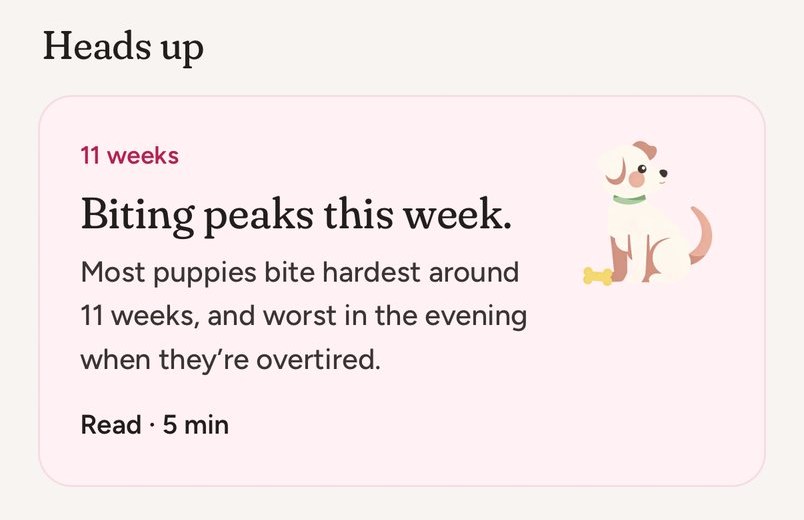
A Heads up card on Pawly's Today screen: 11 weeks. Biting peaks this week. Most puppies bite hardest around 11 weeks, and worst in the evening when they're overtired. Read, 5 minutes.
Today, Heads up: what the research says about his age, in the week it matters.

What it is

Pawly's library of research: studies, veterinary references and guidance from professional bodies, each graded for how much weight it can carry.

How it was gathered

Collected from published research and veterinary and behavior references, then graded on the scale further down this page.

How Pawly uses it

Each plan starts from a real owner problem. Around 30 passages are ranked, and the plan is written from the ones that hold up.

Every safety line is checked against published veterinary references.

What it isn't good for

Some everyday problems have little science behind them. The research is deep on socialization, growth and vet care, and thin on biting, chewing, jumping, barking and leash work, so plans there lean on experienced trainers.

A study about dogs in general can't tell you about your dog. That's what a plan's check-ins are for.
Room 2 of 4

2.7M+

Words from working dog trainers

Across 681 transcripts

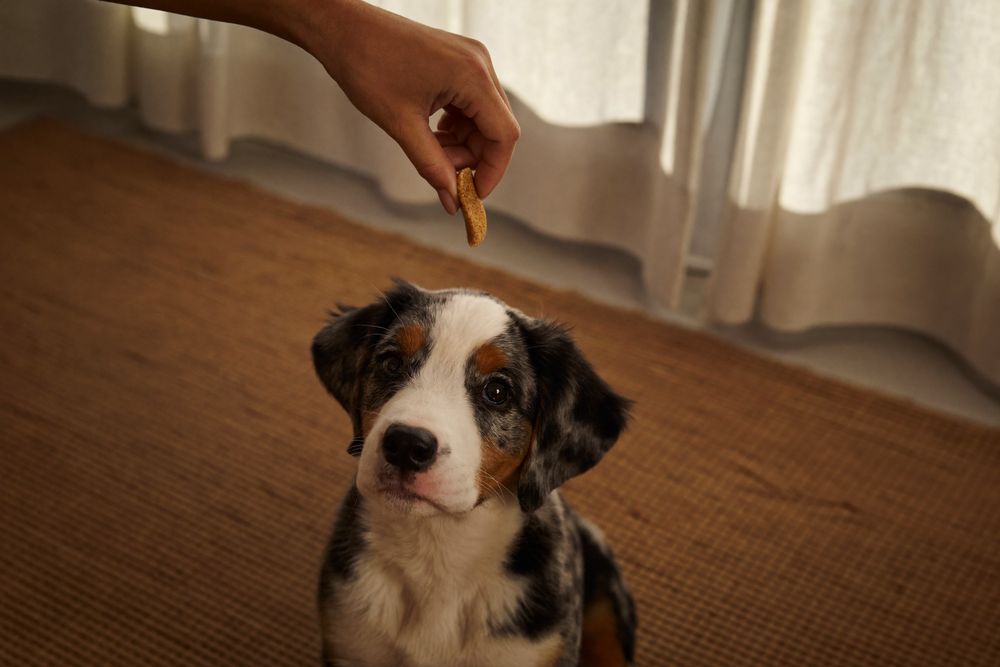
A hand holds a treat above a merle puppy, who sits and looks up at it.

What it is

Transcripts of working dog trainers explaining how they teach, taken from their videos and podcasts.

How it was gathered

Transcribed from trainers' public videos and podcasts. Videos made for other audiences, such as police dogs and bite sport, are filtered out.

How Pawly uses it

It covers the everyday topics science is thin on: biting, leash, barking, jumping and chewing. Plans draw on it, and trainer names stay out of the app's pages.

ComingLessons that play a trainer's own video, matched to your puppy.

What it isn't good for

A trainer mentioning a topic isn't the same as good advice on it. Coverage tells us a topic comes up. It doesn't tell us the method is right for your dog.

Nothing here means a trainer endorses Pawly.

Room 3 of 4

7,162

Dog-food products catalogued

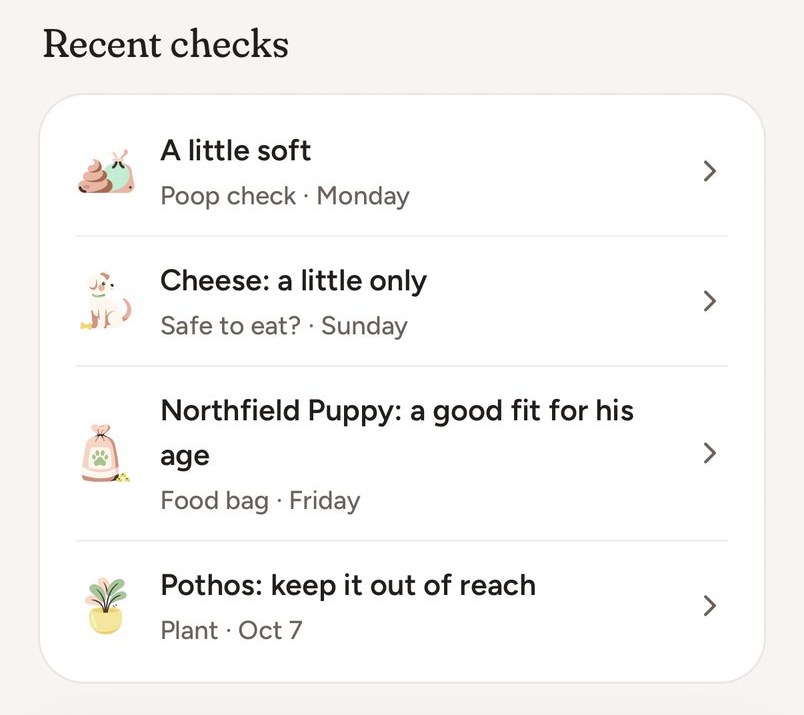
Fig. 2Where you'll see it in the app

Recent checks on Pawly's Capture screen: A little soft, poop check, Monday. Cheese: a little only, safe to eat, Sunday. Northfield Puppy: a good fit for his age, food bag, Friday. Pothos: keep it out of reach, plant, October 7.
Capture, Recent checks: a food-bag read sits beside his other checks. Which checks are live today: confirm with Jake.

What it is

A catalogue of dog foods and what their labels say.

How it was gathered

[How the catalogue was built, and how often it's refreshed: to confirm with Jake]

How Pawly uses it

It sits behind the food-bag check in Capture. Photograph a bag, and Pawly reads it with your puppy's age and feeding plan in mind.

What it isn't good for

A label isn't a lab test, and a catalogue can't tell you how a food will suit your dog. It doesn't replace your vet on diet, allergies or a puppy who's unwell.

If we ever earn money from a food link, we'll say so on this page.

Room 4 of 4

~10M

Public owner discussions

2008 to 2026.

Fig. 3Where you'll see it in the app

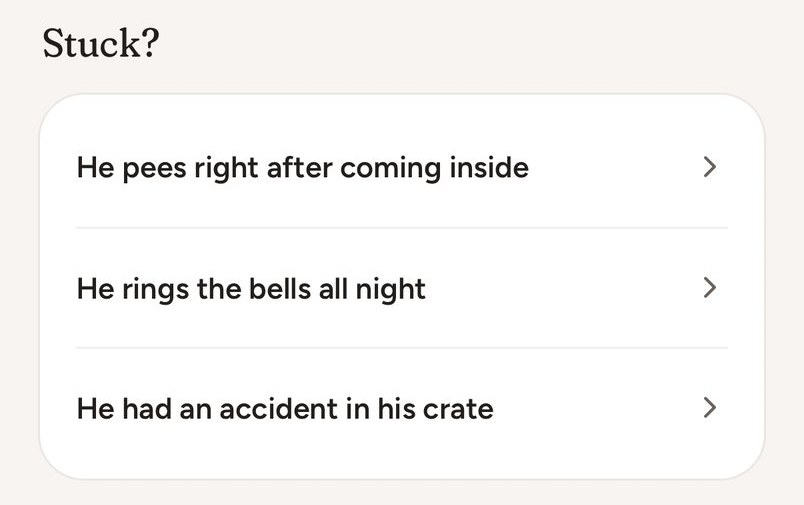
The Stuck? list on Pawly's Potty screen: He pees right after coming inside. He rings the bells all night. He had an accident in his crate.
Potty, Stuck?: each plan is titled the way owners say it.
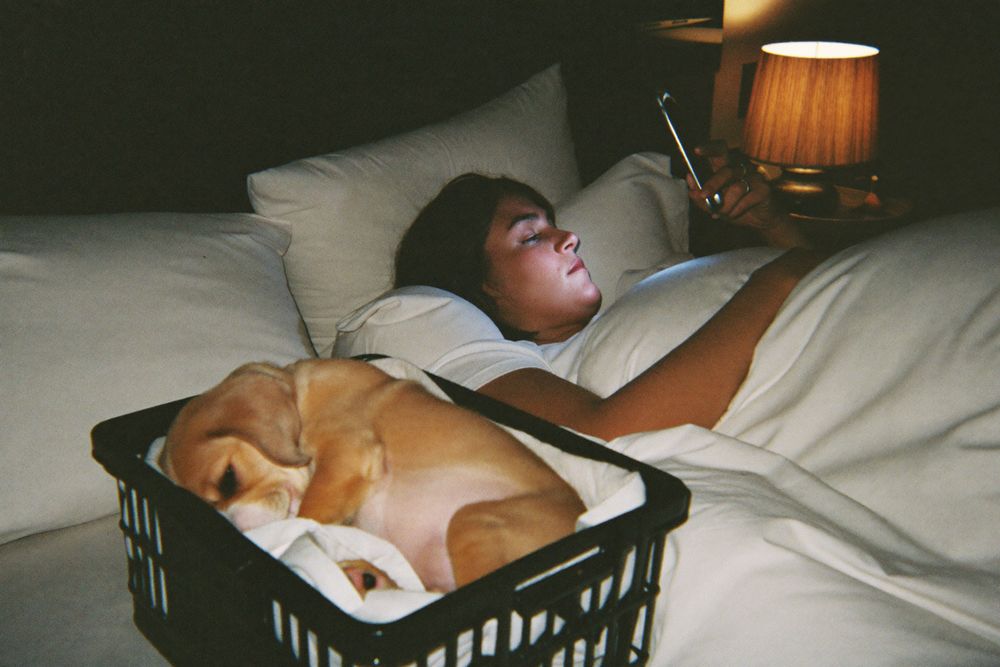
Late at night, a woman in bed reads her phone by lamplight while her puppy sleeps in a basket beside her.

What it is

Public online conversations where dog owners describe their problems in their own words.

How it was gathered

Collected from public forums where owners talk about their dogs. Usernames are masked one way, so we read the words and not the people. Conversations about grief are set aside by default.

How Pawly uses it

This is where Pawly learns how owners talk: the 3am cry, the land shark hour, the puppy blues. Plan titles are written in those words.

What it isn't good for

Counting. People post when something is wrong, so these discussions can't tell us how common anything is. We never turn them into "most owners" or a percentage.

They can't diagnose anything either.

Draft scale: to confirm with Jake

How sources are graded.

Each source is graded by how much weight it can carry. The scale runs from strong consensus down to unsupported, which Pawly doesn't recommend.

  1. Strong consensus

    Good studies and professional bodies agree.

  2. Moderate evidence

    Good support, with gaps or limits.

  3. Plausible but uncertain

    It makes sense and may help. The evidence is thin.

  4. Owner-specific hypothesis

    A guess about your dog in particular, to test with check-ins and adjust.

  5. Unsupported

    Not recommended.

How we read owners

Emotion is the engine. Evidence is permission. Outcome is proof.

Pawly's research doctrine, from Jake, co-founder (engineering and AI).

Owners care a lot, and caring a lot isn't irrational. The owner who worries at 3am is often the same one who wants studies, sources and reasons before acting.

So Pawly starts from what you're feeling, shows where its advice comes from, and judges itself by what changes for your dog.

Effort can be part of the care. Pawly takes away drudgery and leaves the rituals that make you feel like you're looking after him.

The relationship

Why the relationship is part of the model.

A dog lives inside a relationship, and the science says the bond is real on both sides. It overlaps with the bonds people form with children. It isn't the same.

  • Stoeckel et al., 2014PLOS ONE

    Mothers' brains responded to their own dog and their own child in overlapping ways, with real differences too.

  • Nagasawa et al., 2015Science

    Mutual gaze between dogs and their owners was linked to rising oxytocin in both.

  • Berns, Brooks and Spivak, 2015Behavioural Processes

    In awake dogs, the scent of a familiar person drew a strong response in a reward-related part of the brain.

  • Topál et al., 1998Journal of Comparative Psychology

    Dogs showed attachment-like behavior toward their owners in an adapted Strange Situation test.

  • Kurdek, 2008Journal of Social and Personal Relationships

    Across 923 people, pet dogs showed key features of attachment figures, such as being a secure base.

Safety first

When it's urgent, the reading comes last.

  1. What to do now. The first thing Pawly shows you in a scary minute.
  2. When to call your vet. Said plainly, before any explanation.
  3. Then the reading. The why, for when everyone is safe.

Pawly isn't a vet and doesn't diagnose. Safety lines in every plan are checked against published veterinary references.

When Pawly isn't the right tool

If your dog isn't breathing, has collapsed, is bleeding heavily or may have eaten something poisonous, call your vet or an emergency animal hospital now. Don't wait on an app.

See the research at work on your puppy.

Pawly is in beta on iPhone. Researchers and partners can write to jake@pawlytechnologies.com.