
Request beta access

Technology demo

Twenty seconds of Lucas, seen by our models.

Running time
20 seconds
Shot on
One iPhone
Collar
None
Sensors
None
Starring
Lucas, Jake's dog

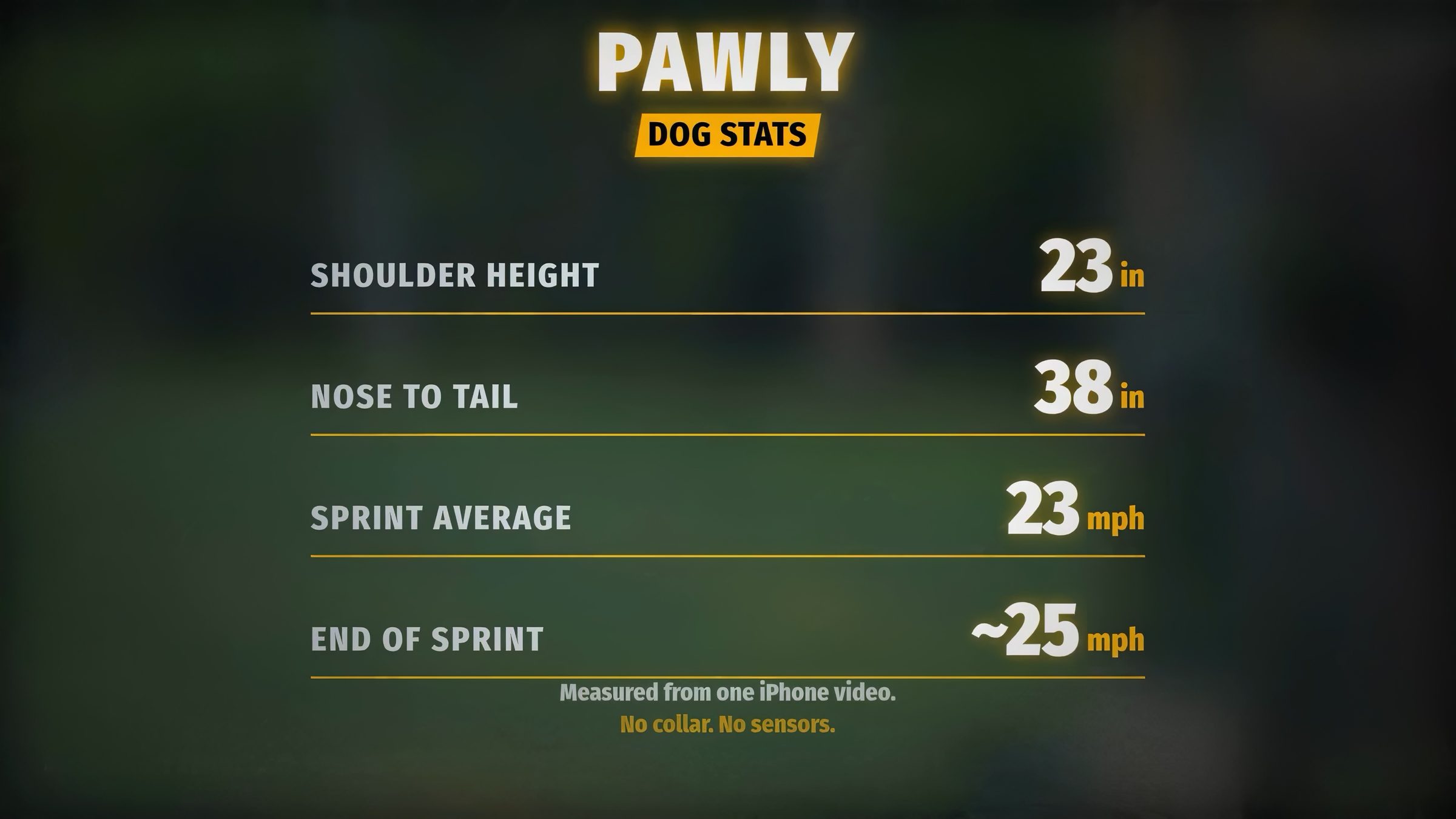
Fig. 01 What the film shows. Lucas sprints down a wooded path after a throw while a pose model traces him and the 6'2" person in the shot serves as the ruler. His path is then drawn over a 3D model of a front yard, out to the ball and back. It ends on his stats: shoulder 23 in, nose to tail 38 in, sprint average 23 mph, end of sprint about 25 mph. The film has no sound.

Measurements One dog · one clip

Measured from one iPhone video. No collar. No sensors.

These are Lucas's numbers from one technology demo. Measuring a dog this way is lab work today. It isn't a feature in the Pawly beta.

Shoulder height
23in1
Nose to tail
38in2
Sprint average
23mph3
Top speed
about 25mph4
  1. 1Shoulder height: one measurement of one dog, Lucas, from one clip, scaled against the 6'2" person in the frame. A single demonstration, not an accuracy study. Method and limits to be confirmed by Jake.
  2. 2Nose to tail: one measurement from the same clip. A single demonstration. Method and limits to be confirmed by Jake.
  3. 3Sprint average: averaged over one sprint after one throw. A single demonstration. Method and limits to be confirmed by Jake.
  4. 4Top speed: the film's "end of sprint" reading, about 25 mph, from one sprint. A single demonstration. Method and limits to be confirmed by Jake.

Chapters

The film, chapter by chapter.

Five chapters, in the order they play. The letters on each frame mark what the models are doing. How the yard model and path are built: to confirm with Jake.

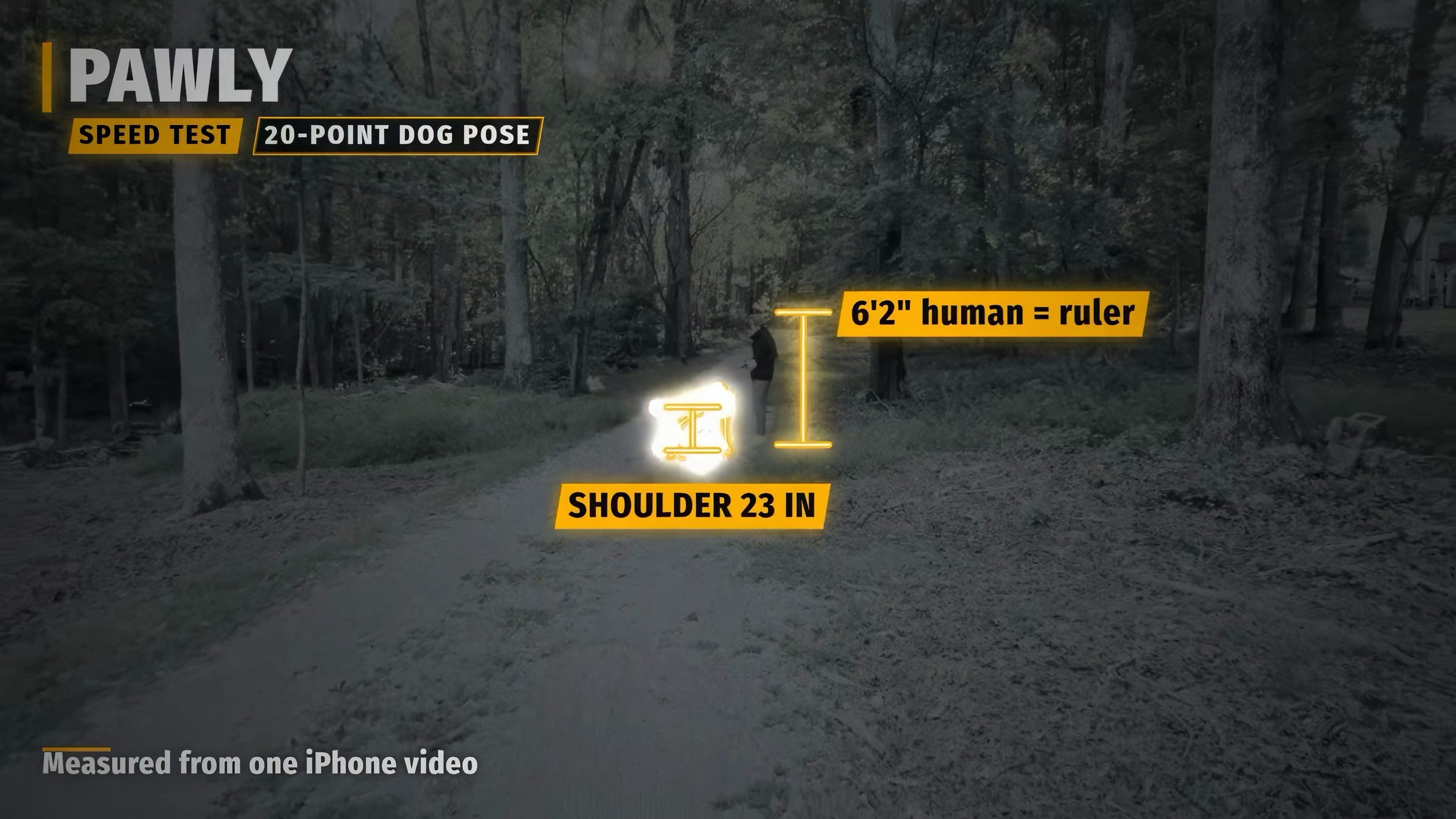
Film frame: Lucas glows as a traced pose on a wooded path. A bracket beside the person in the shot reads 6 foot 2 human equals ruler, and a label reads shoulder 23 in.
Fig. 1.1Looping0:00–0:05

Chapter 01

Speed test

A pose model places 20 points on Lucas in every frame, and the 6'2" person in the shot gives the scale for size and speed.
  • A: The 20-point dog pose
  • B: The person in the shot, used as a 6'2" ruler
  • C: Shoulder height, read off the pose
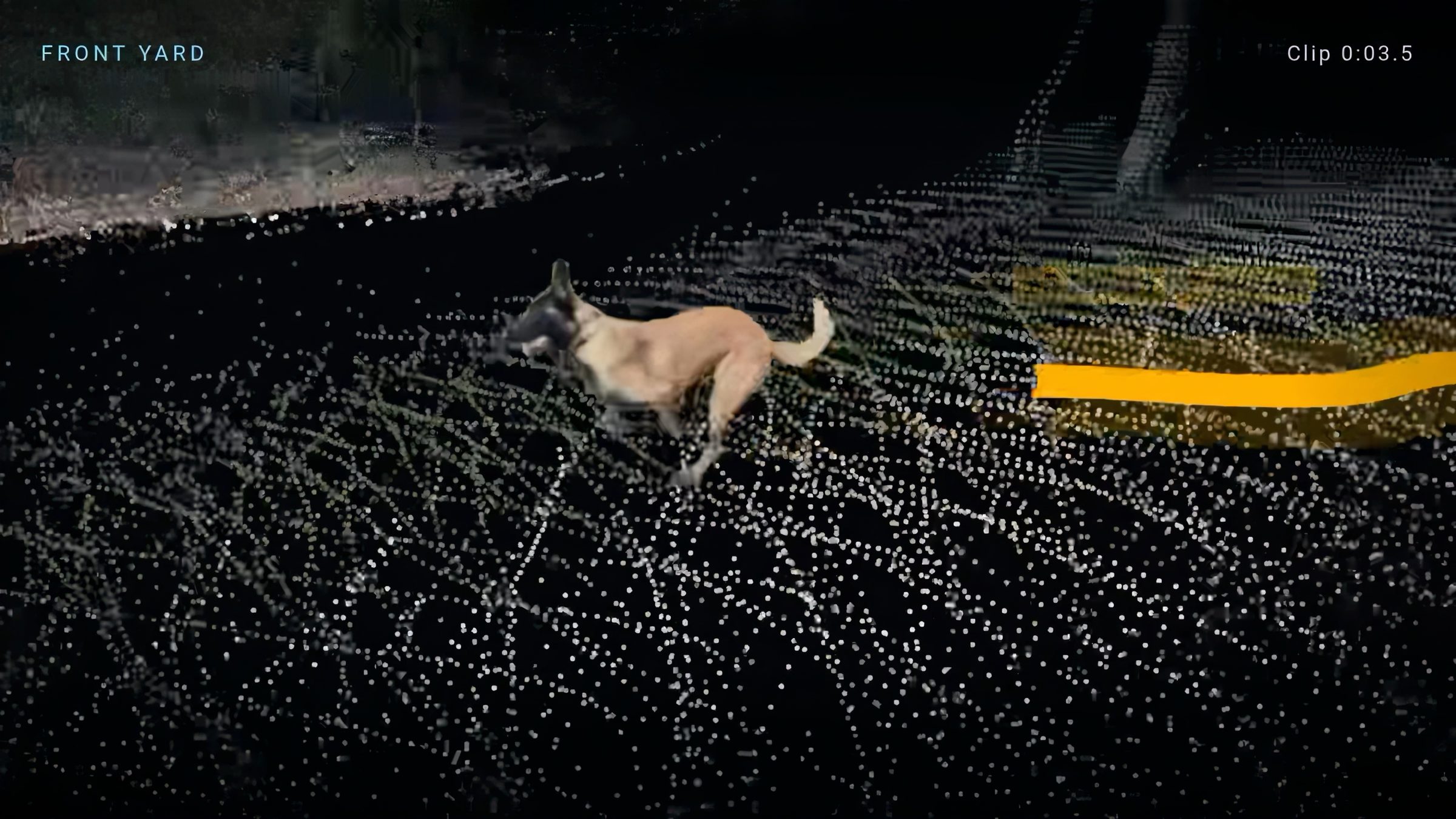
Film frame: Lucas, cut out from the footage, runs across a 3D point-cloud model of the front yard, with an amber path behind him.
Fig. 1.2Looping0:05–0:12

Chapter 02

Following Lucas

Lucas is tracked out of the footage and followed across a 3D model of the front yard, with his real path drawn as he runs.
  • A: Lucas, tracked and lifted out of the video
  • B: The front yard as a 3D point cloud
  • C: His path, drawn where he ran
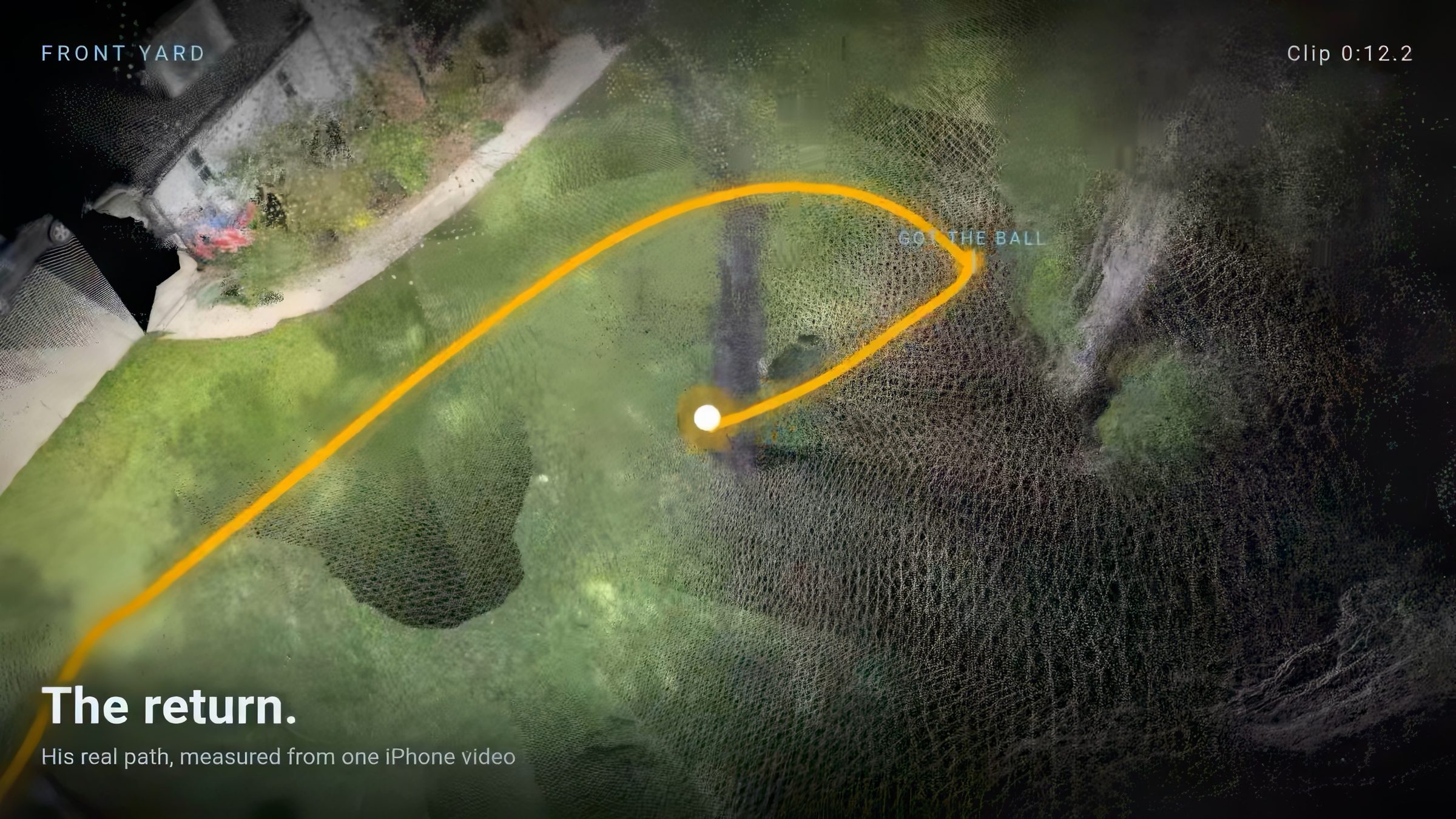
Film frame: seen from above, an amber path curves out to a point labelled got the ball and turns back toward a white dot marking Lucas.
Fig. 1.3Looping0:12–0:15

Chapter 03

The return

After the pickup the path turns for home, and the tracking keeps the curve of the turn.
  • A: The pickup, where he got the ball
  • B: Where Lucas is now
  • C: The run out
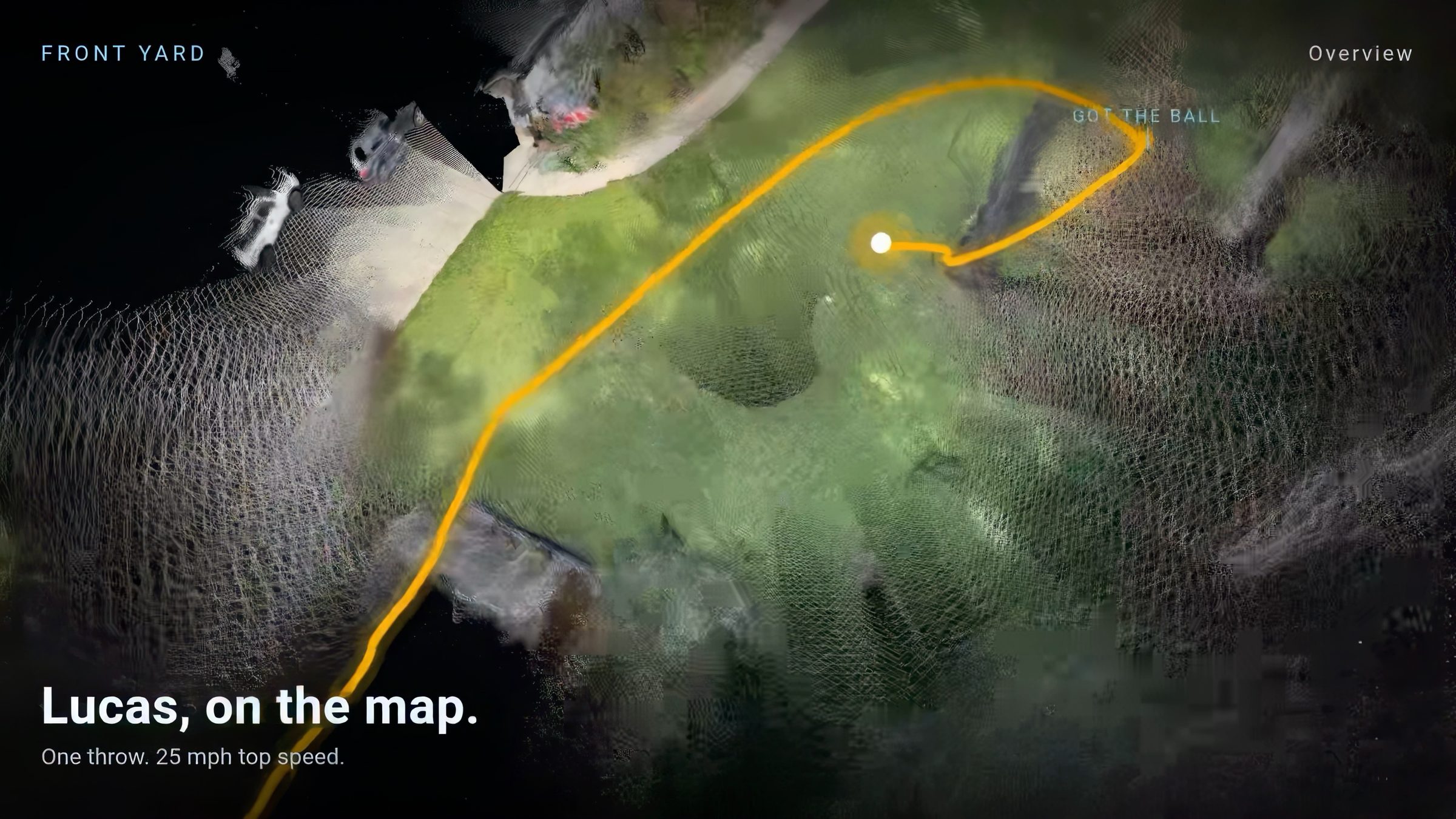
Film frame: an overhead 3D map of the front yard, with the house, driveway and cars, and the whole run drawn as one amber line.
Fig. 1.4Looping0:15–0:18

Chapter 04

On the map

Seen from above, the whole throw becomes one line on a map of the yard: out, the pickup, and back.
  • A: The whole run, start to finish
  • B: The house and driveway, for context
  • C: The pickup
Film frame: the dog stats card. Shoulder height 23 in, nose to tail 38 in, sprint average 23 mph, end of sprint about 25 mph. Measured from one iPhone video. No collar. No sensors.
Fig. 1.5Looping0:18–0:20

Chapter 05

Dog stats

The film ends on Lucas's numbers, each taken from that one clip.

  • A: Shoulder height, 23 in
  • B: Nose to tail, 38 in
  • C: Sprint average 23 mph, end of sprint about 25 mph

Stack

What's underneath.

The pieces behind the film and behind Pawly's guides, one line each.

  1. Fine-tuned models

    Models we fine-tune ourselves for dogs and the people who live with them.

  2. Dog pose

    A pose model that places 20 points on a dog's body, frame by frame.

  3. Dog and handler tracking

    Two-body tracking that follows the dog and the person together, so a person of known height can be the ruler.

  4. Guide pipeline

    Each plan starts from a real owner problem, ranks around 30 research passages and is written from the ones that hold up.

  5. Self-run GPUs Jake to confirm before publishing

    Our models run on GPUs we operate ourselves.

Camera

In development

The video stays between the camera and your phone.

We're building camera hardware for the home. It starts from one privacy principle: what the camera films goes to the owner's phone, and stays between the two.
Status
In development
Privacy
Video stays between the camera and the owner's phone
Details
[Specs, timing and what runs on the device: to confirm with Jake]
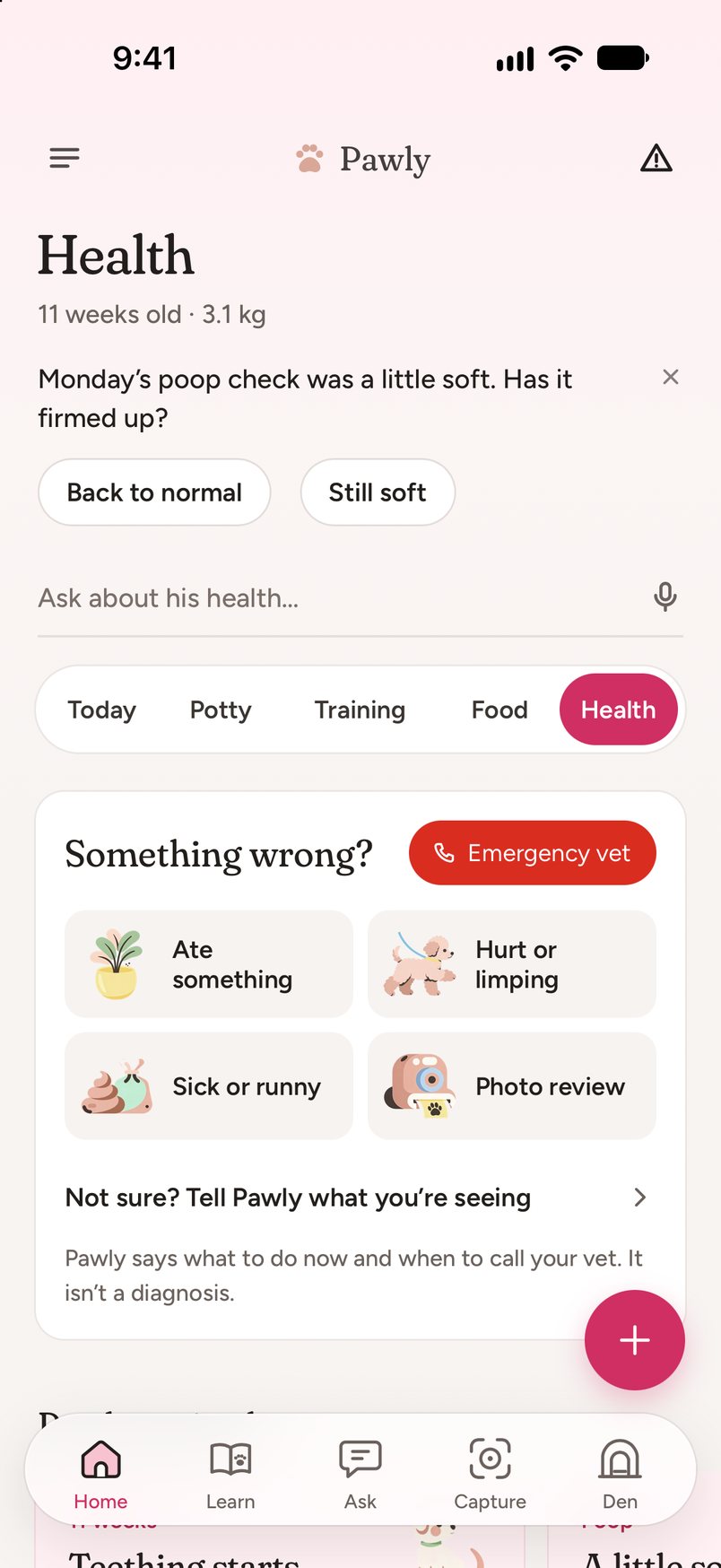
Pawly's Health screen. A card titled Something wrong? has a red Emergency vet button and four doors: Ate something, Hurt or limping, Sick or runny, Photo review. Below: Pawly says what to do now and when to call your vet. It isn't a diagnosis.

Fig. 03Pawly's Health screen.

In the app

What this means for your puppy.

A phone that can see a dog already shows up in Pawly's beta, in smaller and everyday ways.

  • Film one rep

    In the beta

    Film your puppy doing sit, down, stay, recall or shake, and Pawly checks the rep.

  • Check it with a photo

    In the beta

    "Can he eat this?", a plant, a food bag or a stool: take a photo in Capture and Pawly says what to do now and when to call your vet.

  • Limping

    In the beta

    Limp triage in Capture helps you decide what to do now and when to call your vet. It isn't a diagnosis.

  • Measuring size and speed

    In the lab

    What you saw in Lucas's film. It isn't in the app yet.

Feature status to confirm with Jake before launch.

See how Pawly works